
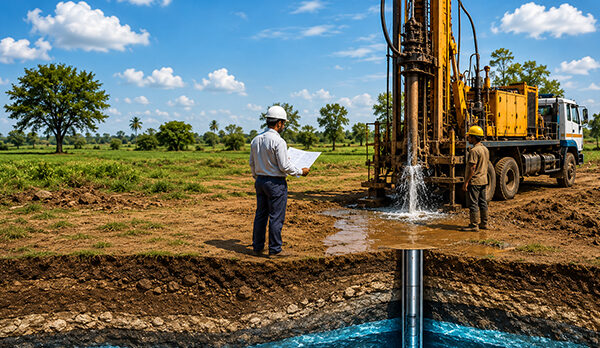
Searching for a “Borewell Drilling Contractor Near Me” usually means you need more than a drilling machine. You need a contractor who can understand your site, check groundwater conditions, select a suitable drilling method and support the project from drilling to pump installation.
For property owners in Ahmedabad, the nearest borewell contractor is not always the right one. A better choice is a contractor with local field experience, proper drilling equipment, clear communication and complete groundwater support.
Jaldhara Borewell provides borewell drilling and groundwater services for residential, agricultural, commercial and industrial projects across Ahmedabad, Gandhinagar and nearby areas. Its services include borewell drilling, tubewell drilling, hydrogeological surveys, casing support, submersible pump installation, cleaning, flushing, repair and rainwater harvesting.
This guide explains what to check before selecting a local borewell contractor and how to avoid common mistakes.
Understand the Property’s Water Requirements
Before selecting a location, determine why the borewell is required. A residential property may need water for bathrooms, washing, gardening and storage tanks. An agricultural farm may require a higher discharge for crop irrigation, orchards or dairy activities.
Factories, warehouses, hospitals, schools and commercial buildings may have different daily consumption requirements. Consider:
- Expected daily water demand
- Number of users
- Required pumping hours
- Water-storage capacity
- Irrigation or industrial use
- Future expansion plans
These details help the contractor plan the bore diameter, casing arrangement, expected depth and suitable pump capacity.
Arrange a Hydrogeological Survey
A hydrogeological survey examines the site’s terrain, soil, rock formations, drainage patterns and possible groundwater-bearing zones. The survey can provide useful information for selecting a drilling point and planning the drilling method.
However, groundwater occurs naturally below the surface. No survey or contractor can guarantee its availability, quantity or quality before drilling. A survey should be treated as a technical planning method that helps reduce uncertainty.For borewell drilling projects in Ahmedabad, a site assessment may be particularly helpful where plots have limited space, nearby borewell results vary or underground construction is present.
Review Nearby Borewell Information
Information from neighbouring properties can provide useful local guidance. Property owners may ask about:
- Approximate borewell depth
- Ground formations encountered
- Static and pumping water levels
- Seasonal changes in water flow
- Casing requirements
- Water-quality concerns
Nearby information should only be used as a reference. Underground soil layers, rock fractures and water-bearing formations can change within a short distance. A depth that works on one property may not provide the same result on another site.
Avoid Contamination Sources
The proposed drilling point should be kept away from possible contamination sources such as septic tanks, soak pits, sewage lines, open drains, waste-storage areas and chemical-handling zones.
Polluted surface water may enter underground formations through weak soil, damaged casing or an unprotected borewell opening. Residential properties should also check the direction of drainage and wastewater movement.
For industrial borewell projects, consider chemical-storage areas, effluent pipelines, treatment plants and waste-disposal locations before selecting the drilling point.
Check Underground and Overhead Utilities
Before drilling begins, identify utilities and structural elements near the proposed location. These may include:
- Underground water pipes
- Sewer and drainage lines
- Electrical cables
- Gas or communication lines
- Building foundations
- Basements and underground tanks
- Overhead electrical wires
- Balconies, sheds and trees
Drilling without checking these elements may cause safety risks, property damage and project delays. The drilling area should be confirmed with the property owner, contractor and relevant utility authorities.
Ensure Access for the Drilling Machine
A location may appear suitable from a groundwater perspective, but the drilling rig must be able to reach and operate safely at the site.
Check the entrance width, gate height, turning space, ground stability and working clearance. There should also be space for drilling rods, casing pipes, support vehicles, workers and removal of drilling residue. Machine access is especially important for homes, apartment buildings and commercial properties in developed areas of Ahmedabad, where plots and internal roads may be narrow.
Consider Present and Future Construction
The borewell should not be placed where future construction may block access. Review the planned building footprint, parking area, basement, driveway, garden, water tank and rainwater harvesting system.
A borewell may require cleaning, pump removal, camera inspection or repair in the future. Therefore, the location should remain accessible after construction is completed.Avoid placing the borewell directly below a permanent structure or in an area where maintenance equipment cannot reach it later.
Plan the Pump and Pipeline Route
The borewell location should allow an efficient connection to the submersible pump, electrical panel and water-storage tank.
Consider:
- Delivery-pipe distance
- Vertical delivery height
- Cable length
- Water-tank location
- Required water pressure
- Space for the control panel
- Access for pump removal
The pump should be selected after drilling according to the completed bore depth, water level, available discharge, pipe size and delivery requirements. Selecting a pump only by horsepower may result in inefficient operation.
Avoid Low-Lying and Waterlogged Areas
Low-lying areas may allow rainwater, mud, sewage or debris to collect around the borewell opening. This can increase contamination and maintenance risks.
Select a location with proper surface drainage. The borewell opening and casing should be suitably sealed and protected after installation.The ground must also be stable enough to support the weight of the drilling rig. Soft, filled or waterlogged land may require preparation before the equipment is positioned.
Coordinate with Rainwater Harvesting
Where conditions permit, the borewell project can be coordinated with a rainwater harvesting or groundwater recharge system.
Filtered rooftop rainwater may be directed to a properly designed recharge structure to support groundwater replenishment. However, unfiltered surface runoff should not be allowed to enter the borewell directly.
The recharge system should be planned according to rainfall, available space, soil conditions and local groundwater characteristics.
Borewell Site Selection in Ahmedabad
Jaldhara Borewell provides site assessment and borewell drilling support for residential, agricultural, commercial and industrial properties across Ahmedabad, Gandhinagar and nearby areas.
The project plan considers geological conditions, drilling access, expected depth, casing requirements and daily water demand. Related services include hydrogeological surveys, borewell drilling, casing installation, cleaning, water-yield testing and submersible pump installation.
Conclusion
Choosing the right borewell location requires more than finding an empty space. Geological conditions, contamination sources, underground utilities, drilling-machine access, construction plans and pump connections should all be assessed before work begins.
A site-based drilling plan can support safer execution and better coordination between the borehole, casing, pump and water-delivery system. Although groundwater availability cannot be guaranteed, careful planning can reduce avoidable risks and help develop a borewell system suited to the property’s actual requirements
we denounce with righteous indignation and dislike men who are so beguiled and demoralized by the charms of pleasure of the moment.
Denounce with righteous indignation and dislike men who are so beguiled and demoralized by the charms of pleasure of the moment.