Borewell Drilling Services in Ahmedabad
Access to a dependable water supply is essential for homes, farms, industries, commercial establishments and infrastructure projects. As groundwater continues to play a vital role in meeting water demands across Gujarat, professionally executed borewell drilling has become one of the most effective ways to secure a long-term and independent water source.
At Jaldhara Borewell, we provide professional borewell drilling services tailored to the geological conditions of Ahmedabad, Gandhinagar and North Gujarat. With more than 30 years of field experience, we combine technical expertise, modern drilling equipment and a systematic approach to help clients develop reliable groundwater solutions for a wide range of applications.
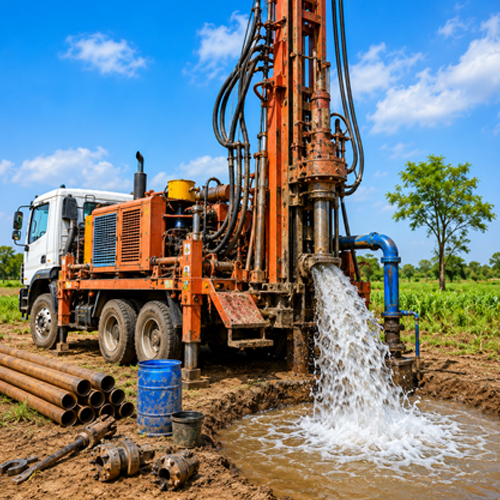
Whether you are constructing a new home, expanding an agricultural operation, developing an industrial facility or planning a commercial project, our team works closely with you to understand your water requirements and recommend a borewell solution suited to your site’s conditions.
From initial consultation and site assessment to drilling, casing installation, borewell development and commissioning, we provide end-to-end support with a strong focus on quality, safety and long-term performance.
What Is Borewell Drilling and How Does It Work?
Borewell drilling is the process of creating a deep, narrow bore in the ground to access groundwater stored within underground rock and soil formations called aquifers. After reaching a suitable water-bearing zone, casing pipes may be installed to support the borehole, followed by a submersible pump for water extraction.
A borewell does not create water; it provides access to groundwater already available below the surface. Its performance depends on the drilling location, geological conditions, aquifer characteristics, borewell construction, groundwater recharge and regular maintenance. For projects in Ahmedabad, a site assessment can help determine suitable drilling and casing requirements.
Why Proper Borewell Planning and Drilling Matter
A borewell is a long-term water infrastructure investment for homes, farms, commercial properties and industrial facilities. Careful planning, suitable drilling methods and proper borehole construction can improve operational efficiency and reduce avoidable maintenance problems.
For borewell projects in Ahmedabad, the drilling plan should consider site access, geological formations, expected depth, bore diameter, casing requirements and intended water demand.
- Suitable Drilling Point Selection
- Improved Borehole Stability
- Better Pump Performance
- Accurate Drilling Execution
- Appropriate Casing Installation
- Reduced Maintenance Risks
Poor planning or unsuitable workmanship may lead to borehole instability, sediment entry, reduced water flow and frequent repair requirements. Choosing an experienced borewell contractor in Ahmedabad helps ensure that every stage—from site assessment and drilling to casing and pump installation—is handled according to actual project conditions.
Introductory paragraph
Groundwater needs vary according to property type, daily consumption, site access and geological conditions. Jaldhara Borewell undertakes borewell drilling projects across Ahmedabad for homes, farms, factories, commercial properties and institutional developments.
Residential Borewell Drilling
Borewell drilling for homes, villas, apartments and housing societies requiring an additional groundwater source. Planning considers available space, daily water demand, bore depth, casing and suitable pump capacity.
Agricultural Borewell Drilling
Farm borewell drilling for crop irrigation, orchards, nurseries and dairy operations. The drilling plan is developed according to land conditions, irrigation demand and expected groundwater depth.
Industrial Borewell Drilling
Industrial borewell drilling for factories, warehouses, textile units, engineering plants and processing facilities. Bore diameter, expected discharge and pump requirements are planned according to operational water demand.
Commercial Borewell Drilling
Groundwater solutions for hotels, hospitals, schools, colleges, offices and commercial buildings where daily water consumption may vary according to occupancy and business activity.
Infrastructure & Institutional Projects
Borewell and groundwater services for educational campuses, construction sites, public facilities and environmental monitoring projects, including drilling, casing and piezometer well requirements.
Our Borewell Drilling Process in Ahmedabad
Every borewell project begins with understanding the property’s water demand, site accessibility and geological conditions. Jaldhara Borewell follows a structured drilling process for residential, agricultural, commercial and industrial projects across Ahmedabad, Gandhinagar and North Gujarat.
Our process covers initial consultation, groundwater assessment, borewell planning, drilling, casing installation, cleaning, water yield testing and submersible pump installation. Each stage is planned according to the actual ground conditions and drilling results to support safe construction, suitable pump selection and efficient borewell operation.
Step 1: Understanding Your Water Requirement
Every project starts with understanding why the borewell is being installed.
Different properties have different water requirements, and this influences the planning of the entire project.
During our initial consultation, we discuss:
- Residential, agricultural or industrial water requirements
- Daily water consumption
- Future expansion plans
- Existing water sources
- Site accessibility
- Project objectives
This helps us recommend the most suitable borewell drilling solution for your property instead of applying a one-size-fits-all approach.
Step 2: Site Assessment & Project Planning
Before starting any borewell drilling work, our team evaluates the site to understand physical and operational conditions.
The assessment includes:
- Suitable drilling location
- Equipment accessibility
- Nearby buildings and utilities
- Ground conditions
- Available working space
- Safety considerations
Proper planning allows our borewell drilling contractor team to execute the project efficiently while minimising disruptions.
Step 3: Groundwater & Geological Evaluation
One of the most important aspects of professional borewell drilling is understanding the local geology.
Groundwater is stored within underground formations known as aquifers, and these formations vary significantly from one location to another.
Our regional experience across Ahmedabad, Gandhinagar and North Gujarat helps us evaluate:
- Geological formations
- Groundwater behaviour
- Local drilling conditions
- Aquifer characteristics
- Seasonal groundwater trends
Although no contractor can ethically guarantee groundwater before drilling, careful planning based on regional knowledge helps improve project decisions.
Step 4: Borewell Drilling Operations
Once planning is complete, the borewell drilling process begins using modern drilling equipment suited to the geological conditions of the site.
During drilling, our experienced operators continuously monitor:
- Soil and rock formations
- Drilling progress
- Borehole stability
- Water-bearing zones
- Formation changes
Continuous monitoring enables informed decisions throughout the project and supports high-quality workmanship.
Step 5: Borewell Casing Installation
Depending on the geological conditions encountered during drilling, casing pipes may be installed to strengthen and protect the borewell.
Proper casing helps:
- Stabilise the borehole
- Prevent collapse in loose formations
- Reduce contamination risks
- Improve structural integrity
- Support long-term performance
Selecting appropriate casing materials is an important part of delivering reliable borewell drilling services.
Step 6: Borewell Development & Cleaning
After drilling is complete, the borewell is developed to remove fine particles, drilling residue and loose sediment.
This stage helps:
- Improve groundwater flow
- Increase water clarity
- Prepare the borewell for testing
- Enhance long-term efficiency
Professional borewell development is essential for achieving dependable performance after drilling.
Step 7: Water Yield Assessment
Every borewell performs differently because groundwater availability depends on local geological conditions.
Water yield assessment helps determine:
- Water production capacity
- Pump selection requirements
- Suitability for the intended application
- Long-term operational planning
This ensures that the groundwater system is designed around actual site conditions rather than assumptions.
Step 8: Submersible Pump Selection & Installation
Selecting the correct pump is just as important as drilling the borewell itself.
Our team considers factors such as:
- Borewell depth
- Water level
- Water yield
- Required discharge
- Daily water demand
A properly selected submersible pump improves efficiency, reduces energy consumption and supports reliable long-term operation.
What You Can Expect from Our Borewell Drilling Process
Jaldhara Borewell follows a planned drilling approach based on site access, geological conditions, water requirements and actual findings during drilling. This helps coordinate borewell construction, casing selection, cleaning, testing and pump installation for projects across Ahmedabad and nearby areas.
- Site-Specific Project Planning
- Improved Borehole Stability
- Reduced Maintenance Concerns
- Suitable Drilling Method
- Accurate Pump Selection
- Support for Different Project Types
Rather than focusing only on drilling, we focus on building a complete groundwater system that continues to perform reliably for years to come.
Expert Insight
A productive borewell is not determined by depth alone. The presence of productive aquifers, favourable geological formations, proper drilling practices and suitable borewell development all play a vital role in the long-term performance of a groundwater system.
This is why every professional borewell drilling project should begin with careful planning rather than assumptions.
Looking for Professional Borewell Drilling Services?
Whether you need residential borewell drilling, agricultural borewell drilling, industrial borewell drilling or a specialised groundwater solution, Jaldhara Borewell provides end-to-end services backed by more than 30 years of experience.
From planning and drilling to casing, testing and pump installation, we are committed to delivering reliable borewell drilling services in Ahmedabad, Gandhinagar and North Gujarat with a focus on quality, safety and long-term customer satisfaction.
Technology We Use
| Feature | Benefit to the Client |
| Modern Drilling Rigs | Efficient drilling across varying geological formations |
| Well-Maintained Equipment | Reliable project execution with reduced downtime |
| Site Assessment Expertise | Better planning before drilling begins |
| Experienced Operators | Skilled handling of equipment and changing ground conditions |
| Safety-Focused Practices | Protection of people, property and equipment |
| End-to-End Groundwater Solutions | Support from drilling through testing and pump installation |
Borewell Drilling Cost in Ahmedabad
Borewell drilling cost in Ahmedabad depends on required depth, bore diameter, soil and rock formations, casing length, drilling-machine access, cleaning, testing and pump requirements. Because underground conditions vary from one property to another, an exact quotation should be prepared after discussing the site and project requirements.
Cost Factor How It Affects the Project Drilling depth Deeper drilling generally requires more time and equipment use Ground formation Hard rock and loose soil may require different drilling methods Bore diameter Wider boreholes may increase equipment and material requirements Casing pipes Cost depends on casing type, diameter and installed length Site access Narrow or difficult access may affect machine positioning Pump installation Pump capacity depends on water level, yield and delivery height
Areas We Serve Across Ahmedabad
Jaldhara Borewell serves residential, agricultural, commercial and industrial projects across Ahmedabad, including Danilimda, Maninagar, Isanpur, Narol, Vatva, Odhav, Naroda, Bopal, Sanand, Changodar and nearby areas. Services are also available for selected projects in Gandhinagar and North Gujarat.
Frequently Asked Questions About Borewell Drilling
Borewell drilling is the process of creating a deep, narrow bore into the ground to access naturally occurring groundwater stored in underground geological formations known as aquifers. Once a productive water-bearing zone is reached, the borewell may be fitted with casing pipes and a suitable submersible pump to supply water for residential, agricultural, commercial or industrial use. A professionally executed borewell is designed to provide a reliable and long-term source of groundwater when supported by proper planning, construction and maintenance.
A typical borewell drilling process begins with understanding the property’s water requirements, followed by site assessment and planning. The drilling team then uses specialised equipment to create the borehole while monitoring soil and rock formations encountered during drilling. Depending on ground conditions, casing pipes may be installed to stabilise the borewell. After drilling, the borewell is developed and cleaned, water yield is assessed, an appropriate submersible pump is installed and the system is tested before regular use.
There is no standard borewell depth suitable for every property. The required depth depends on local geological formations, groundwater availability, aquifer characteristics and regional hydrogeological conditions. Two neighbouring properties may require different drilling depths because underground formations can vary over short distances. A responsible contractor evaluates local conditions rather than recommending a fixed depth for every project.
No. Groundwater is a naturally occurring resource, and no contractor can ethically guarantee that a specific quantity of water will be found before drilling. Borewell success depends on factors such as geology, aquifer conditions, rainfall, groundwater recharge and regional water extraction. Be cautious of anyone making claims of “100% guaranteed water,” as such assurances are not supported by scientific evidence.
The duration of a borewell drilling project depends on several factors, including the required drilling depth, geological conditions, site accessibility and project complexity. Residential projects may often be completed more quickly than larger industrial or agricultural installations. In addition to drilling, activities such as site preparation, borewell development, testing and pump installation are also part of the overall process.
Borewell drilling services are commonly used for a wide range of properties, including independent homes, villas, apartment complexes, housing societies, farms, orchards, dairy units, factories, warehouses, hotels, hospitals, schools, colleges, office buildings and infrastructure projects. The design and capacity of the borewell are planned according to the property’s water requirements and site conditions.
The success of a borewell drilling project depends on multiple factors, including geological formations, aquifer characteristics, drilling quality, borewell location, casing installation, groundwater recharge, pump selection and regular maintenance. Drilling deeper alone does not guarantee a better water supply. A productive aquifer at a moderate depth may provide more reliable groundwater than a deeper but less productive formation.
Casing pipes are installed where geological conditions require additional support for the borehole. They help stabilise loose formations, reduce the risk of borehole collapse, minimise sediment entry and protect the structural integrity of the borewell. The type and depth of casing depend on the conditions encountered during drilling.
Not necessarily. The need for casing depends on the site’s geological conditions. Some formations require extensive casing for stability, while others may require little or none. An experienced borewell drilling contractor determines the appropriate casing requirements based on the actual conditions encountered during drilling.
Not always. The location of a borewell should consider accessibility for drilling equipment, surrounding structures, underground utilities, property layout and environmental factors. Choosing a suitable location also helps with future maintenance and efficient use of the water supply.