
Amin Residency, Opp. Good Luck Party Plot
Danilimda, Ahmedabad – 380028, Gujarat
A borewell that delivers less water during summer can create problems for homes, housing societies, farms and factories. Before considering deeper drilling or a larger pump, property owners often ask whether collecting rainwater could help support their existing groundwater source.
A recharge well can help improve borewell water availability when it directs suitable rainwater into a groundwater system connected to the borewell. However, the results depend on rainfall, underground conditions, recharge volume and groundwater extraction. Improvement is possible, but it cannot be guaranteed for every property.
For property owners in Ahmedabad, recharge well planning should begin with a site assessment. Understanding where rainwater comes from and how groundwater moves is essential before choosing a recharge structure.
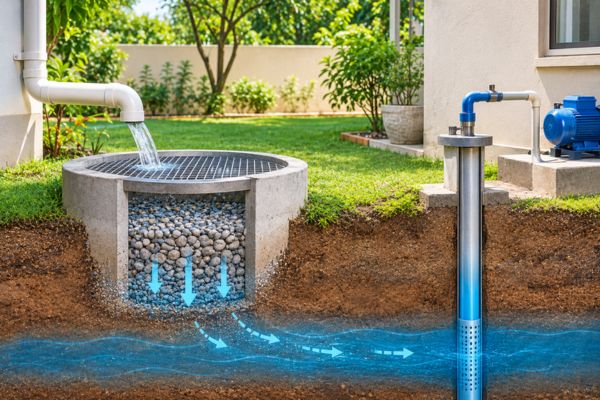
A recharge well provides a planned route for suitable rainwater to enter permeable underground layers. Depending on the design, water may pass through the soil or reach a selected water bearing formation. The purpose is to add water to underground storage. A nearby borewell may benefit if it draws from a formation that receives this recharge. The Central Ground Water Board identifies improved well yield, changes in groundwater levels and longer pumping availability as possible impacts of artificial recharge projects. These outcomes require assessment and monitoring.
No. A recharge well does not automatically improve the output of the nearest borewell. Two wells located close together may reach different underground layers. Water entering one formation may not readily reach the formation supplying the borewell. This means distance alone cannot determine whether a recharge project will help. A suitable assessment considers the receiving aquifer, groundwater conditions and the scope for recharge and extraction. CGWB’s artificial recharge planning guidance includes aquifer assessment as a key part of site specific project planning.
Several conditions influence whether recharge can make a useful contribution.
| Factor | Why It Matters |
|---|---|
| Rainwater collection area | Helps determine the volume available for collection |
| Rainfall and runoff | Affect how much water reaches the system |
| Underground formations | Control where recharge water can move and accumulate |
| Connection to the borewell aquifer | Influences whether the borewell may benefit |
| Water quality | Determines whether the collected water is suitable for recharge |
| Groundwater withdrawal | Affects the balance between water entering and leaving storage |
| System condition | Influences whether water can enter the structure as intended |
These factors should be considered together. A large structure cannot compensate for an unsuitable site or an inadequate rainwater source.
A recharge well may contribute to groundwater replenishment, but restoring a dry borewell should never be promised without investigation. First, the cause of the reduced supply needs to be understood. A pump fault, a blocked component and a falling groundwater level require different responses. Recharge planning addresses groundwater replenishment; it does not replace equipment inspection or borewell condition assessment. Where recharge is suitable, the proposal should explain the target formation, available source water and expected limitations. The goal is to create a technically suitable system with measurable performance.
Water entering the ground needs careful source selection and appropriate treatment. Removing visible leaves and sand does not establish that water is free from dissolved chemicals or microbial contamination. For example, rooftop runoff and runoff from a vehicle handling area present different concerns. Industrial properties need particular care when identifying collection surfaces and keeping potentially contaminated flows separate. CGWB guidance on using existing wells for recharge highlights source water suitability and whether the well reaches a suitable aquifer. Depending on the assessment, the system may require debris screening, first flush diversion, settlement and filtration. The treatment arrangement must match the source water and recharge method.
Start by reviewing the property’s rainwater collection opportunities alongside its existing water supply records.
For a housing society, this may involve examining terrace drainage, collection pipes and available maintenance space. For a factory, the assessment should distinguish suitable roof runoff from process areas and other potentially contaminated surfaces.
Useful information to share with the assessment team includes:
Jaldhara Borewell’s recharge well service includes site assessment, system planning and integration with rainwater harvesting arrangements for Ahmedabad properties.
Record conditions before construction so that later observations have a useful reference.
Monitoring can include groundwater levels, borewell performance, rainfall, pumping hours and the amount of water entering the recharge system where measurement is practical. Comparing records over time is more meaningful than judging success after a single shower.
A rise in water level after the monsoon does not, by itself, prove that one recharge well caused the change. Rainfall and changes in nearby pumping also need consideration. CGWB’s impact assessment framework includes groundwater extraction, water quality and water balance analysis.
There is no fixed timeline. Any response depends on rainfall, recharge volume, underground connectivity and pumping. Monitoring over a suitable period is needed to assess changes.
The location should follow a site assessment. Proximity alone does not confirm underground connectivity, and contamination risks, drainage and construction conditions also matter.
An existing borewell should not be used for recharge without professional assessment. Its construction, aquifer connection, condition and the source water quality must be checked before deciding whether conversion is suitable.
No. Recharge can support groundwater replenishment, but summer supply also depends on available groundwater storage, rainfall and total extraction.
No. A storage tank holds collected rainwater for later use. A recharge structure helps suitable water enter underground formations. A property may consider either approach or a combination after assessment.
Yes. Collection surfaces, inlet points, settlement arrangements and filters need inspection and cleaning. Maintenance requirements depend on the design and the amount of debris or silt entering the system.
A recharge well can form part of a practical groundwater management plan when the source water, site conditions and receiving formation are suitable.
Jaldhara Borewell provides recharge well construction in Ahmedabad. Share your property layout, borewell details and water supply concerns with the team to discuss a site assessment and a suitable rainwater recharge approach.
Danilimda, Ahmedabad – 380028, Gujarat