
Amin Residency, Opp. Good Luck Party Plot
Danilimda, Ahmedabad – 380028, Gujarat
Choosing a borewell pump starts with understanding the water source. Borewell depth and motor horsepower alone cannot tell you which pump will suit your property. The pump must match the water available, the required delivery rate and the height to which water needs to travel.
Water yield testing helps with borewell pump selection by measuring discharge and observing how the water level changes during pumping. These findings help professionals recommend a suitable pump capacity, installation depth and operating schedule. Pumping tests are used to assess well yield and drawdown before selecting pumping equipment.
For homeowners, housing societies, farms and industrial facilities in Ahmedabad, this assessment provides a practical starting point for planning a dependable water supply.
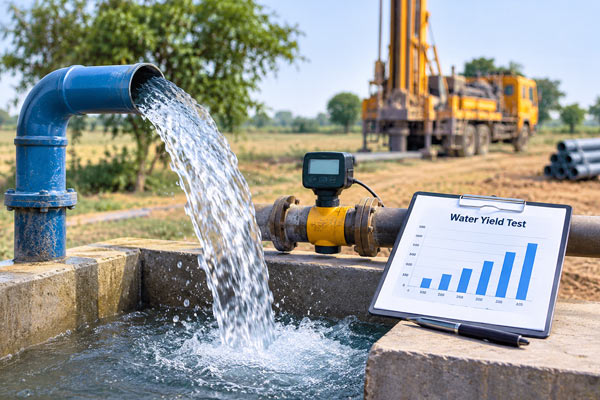
A borewell yield test examines how the well responds when water is pumped out at a measured rate. The water level is monitored during pumping, and recovery readings may be taken after the pump stops.
The results should be read together. A strong flow at the beginning does not, by itself, show how the borewell will perform during longer operation.
| Measurement | What it tells you |
|---|---|
| Static water level | Water level before pumping begins |
| Discharge rate | Volume of water pumped over a measured period |
| Pumping water level | Water level while the pump operates |
| Drawdown | Difference between static and pumping water level |
| Recovery | How the water level rises after pumping stops |
Recording discharge alongside water level changes helps explain the borewell’s response under the tested conditions.
Water yield helps establish a suitable withdrawal rate for the borewell. The selected pump should work within an assessed operating range while meeting the property’s water requirements.
Choosing equipment only because it can deliver a high flow may create a mismatch between the pump and the source. A pump cannot make additional groundwater available simply by having a larger motor.
For example, a property may need water quickly during morning hours, while its borewell needs a longer pumping period to supply that volume. Depending on the assessment, storage may help bridge this gap. Guidance for low yielding wells recognises intermediate storage as one way to manage demand.
The water level during operation helps determine the lift the pump must overcome. It also helps professionals assess an appropriate pump setting.
Borewell depth and pumping water level describe different things. A deep borewell does not automatically require a pump selected solely for lifting water from the bottom.
Pump selection must consider the operating water level, delivery elevation, required outlet pressure and pipe losses. Installation depth also needs to account for submergence and the well’s construction.
This is why a recommendation based only on total drilling depth can leave out essential information.
Yes, but yield alone cannot determine horsepower. It provides part of the information needed to select a pump.
A suitable assessment brings together:
Horsepower, flow and required head are connected selection factors. Comparing pumps at the required operating point is more useful than comparing motor HP alone.
A lower yielding borewell needs a water supply plan that considers both availability and usage. Installing a larger pump should not be the automatic response.
The assessment may identify a need for storage, a revised pumping schedule or further investigation of the borewell’s condition. Storage can allow water to accumulate gradually and serve short periods of higher demand, provided the total available supply is sufficient.
For an Ahmedabad housing society, the planning question could be how to fill a storage tank over an available pumping period. For a farm or factory, the required operating hours and interruptions may be different. These requirements should be discussed before selecting equipment.
Yield testing is useful when planning a pump for a new borewell. Existing test records can also provide a reference when investigating a decline in water output.
Changes in yield, drawdown and recovery can help professionals assess whether the source is performing differently over time. Comparing current findings with earlier records is more useful than relying only on a description such as “water flow has reduced.”
Consider discussing an assessment when replacing a pump, increasing water demand or investigating repeated supply interruptions. The professional can decide which tests and equipment checks are appropriate.
Before approving a pump recommendation, ask for a clear explanation of the proposed flow rate and the conditions used to select it.
Useful questions include:
Keep the test report and pump details for future maintenance. A test records performance under particular conditions; it should not be presented as a guarantee of unchanged water availability throughout the year.
A suitable pump recommendation should explain both what your property needs and what your borewell can supply. Reviewing these together helps turn test readings into a practical installation plan.
Jaldhara Borewell provides water yield testing in Ahmedabad and submersible pump installation in Ahmedabad. Share your borewell records, current water supply concerns and daily requirements with the team to discuss the next steps for assessment and pump selection.
Water yield testing provides useful information about discharge and water level changes during pumping. These readings help professionals select a pump that suits the borewell’s performance and the property’s water requirements.
No. Borewell depth alone is not enough. Pump selection also depends on the pumping water level, required flow, delivery height, pipe losses and available power supply.
A higher HP pump does not increase the groundwater available to a borewell. An oversized pump may withdraw water faster than the well can supply it, causing excessive drawdown and possible supply interruptions.
Borewell yield describes the water a well supplies under assessed conditions. Pump capacity describes the flow a pump delivers at a particular head. The selected pump’s operating flow should suit the assessed borewell performance.
Yes. Current test results can help professionals review whether the replacement should match the old pump or use a different operating capacity. This is especially useful when water output or property demand has changed.
A storage tank may help by collecting water gradually for use during busy periods. However, the borewell’s total available supply must still be sufficient for the property’s overall demand.
No. Yield testing assesses water quantity and borewell performance. Separate laboratory water quality testing is needed to assess whether the water is suitable for drinking.
Jaldhara Borewell provides water yield testing and submersible pump installation services in Ahmedabad. Property owners can discuss their borewell details, water demand and existing supply problems with the team before planning an assessment.
Danilimda, Ahmedabad – 380028, Gujarat