
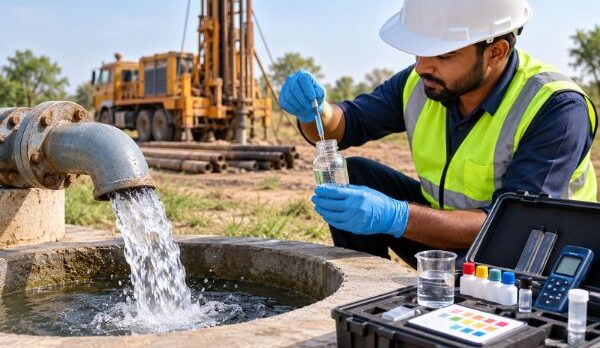
Water Quality Testing for Homes, Societies and Workplaces
Borewell water testing in Ahmedabad helps property owners understand whether groundwater is suitable for its intended use. A borewell may provide enough water, but quantity alone does not tell you its quality. Before using groundwater for drinking, cooking, irrigation or industrial work, choose a test package that matches the application.
Clear water and a normal taste cannot confirm drinking-water safety. A useful assessment combines appropriate laboratory tests with a review of the borewell, storage tanks and treatment system. This guide explains which parameters to discuss, where to collect samples and how to use the report when planning your water supply.
What Is Borewell Water Testing?
Borewell water testing analyses a groundwater sample for selected physical, chemical and, where required, microbiological parameters.
The purpose is to assess suitability for a defined use. Drinking water, irrigation water and industrial process water can require different assessments.
A report describes the sample collected at a particular place and time. It does not guarantee that the water will remain unchanged or that untested contaminants are absent.
Why Should Ahmedabad Property Owners Test Groundwater?
Testing gives homeowners, housing societies and businesses a basis for decisions about water use and treatment.
For an Ahmedabad property, explain the actual supply arrangement to the testing provider. The building may use borewell water directly, blend it with another source, store it in tanks or pass it through treatment equipment.
These arrangements affect the sampling plan. A sample taken at the borewell outlet answers a different question from one collected at a kitchen tap.
Do not assume every borewell in Ahmedabad has the same water quality. Select tests according to the source, intended use and site-specific risks.
Which Water Quality Parameters Should You Test?
Ask the laboratory to recommend a panel based on your application. A basic package may not include microbiological testing or all chemicals relevant to your site.
| Parameter or Test Group | What It Helps Assess |
|---|---|
| pH | Acidity or alkalinity of the sample |
| Total Dissolved Solids (TDS) | Overall dissolved-substance concentration |
| Total Hardness | Hardness associated mainly with calcium and magnesium |
| Turbidity | Cloudiness caused by suspended material |
| Iron and Manganese | Constituents relevant to staining and treatment decisions |
| Chloride and Sulphate | Dissolved salts relevant to intended use |
| Nitrate and Fluoride | Chemical parameters to discuss for drinking-water assessment |
| Coliform Bacteria and E. coli | Indicators used in microbiological assessment |
| Additional Metals or Chemicals | Tests selected according to site history and risk |
Is a TDS Reading Enough to Check Drinking-Water Safety?
No. A TDS reading does not identify individual contaminants or test for disease-causing microorganisms.
A handheld TDS meter can provide a quick indication of dissolved substances. It cannot replace a suitable laboratory assessment. Well-water testing guidance includes bacteria and chemical parameters alongside TDS.
Water with a low TDS reading can still have other quality problems. Likewise, a high reading does not tell you which substances are responsible.
Before choosing treatment, review the relevant chemical and microbiological results rather than relying only on a meter reading.
When Should You Arrange Borewell Water Testing?
Arrange testing before commissioning a new drinking-water supply and when an existing source needs reassessment.
Situations to discuss with your testing provider include:
- A newly drilled or recommissioned borewell.
- Repairs affecting the borewell or water supply system.
- Flooding or suspected entry of contaminated water.
- Changes in colour, smell or taste.
- A change in water source or blending arrangement.
- Installation or modification of treatment equipment.
- A periodic monitoring review.
Testing after monsoon may be useful where the site assessment identifies a reason for it. Choose the schedule with the laboratory instead of assuming one test date suits every property.
Where Should You Collect the Water Sample?
Choose sampling points according to the question you need answered.
| Sampling Point | Purpose to Discuss |
|---|---|
| Borewell Outlet Before Treatment | Assess raw groundwater |
| Storage Tank Outlet | Assess water after storage |
| Before and After Treatment | Compare relevant treatment performance |
| Drinking-Water Tap | Assess water at the point of use |
For a housing society, one sample may not represent every tank or distribution branch. Ask whether multiple locations are needed.
Keep samples separate and clearly labelled. Do not mix water from different sources unless the agreed assessment specifically requires a sample of the blend.
How Should a Water Sample Be Collected?
Follow the laboratory’s instructions before collecting water.
Different tests can require different bottles, preservatives, sample volumes, storage temperatures and delivery times. Microbiological samples require suitable sterile containers and careful handling.
Ask the provider to confirm:
- 1. Who will collect the sample.
- 2. Which sampling points will be used.
- 3. What containers are required.
- 4. Whether flushing or other preparation is needed.
- 5. How samples must be transported.
- 6. When they must reach the laboratory.
Do not rinse bottles unless instructed, because some contain preservatives. Record the date, time, location and treatment status for every sample.
How Do You Read a Borewell Water Test Report?
First check that the sample details match your property and collection point.
Review the parameter list, results, units, test methods and reference criteria. Confirm that the report covers the use you requested.
Useful questions include:
- Were microbiological tests included?
- Which results need action or further assessment?
- Were any required parameters omitted?
- Does a “not detected” result have a stated detection limit?
- Is the report for raw water or treated water?
- Is repeat sampling recommended?
A report marked satisfactory for a limited panel should not be treated as confirmation that every possible contaminant was assessed.
Should You Test Before Installing an RO or Filter?
Yes. Testing helps define the treatment problem before equipment is selected.
Do not assume one system will address hardness, dissolved salts, iron and microbial risks equally. Ask the treatment provider to explain which measured parameters the proposed equipment will address.
After installation, arrange suitable verification testing at the point of use. Keep the report with the equipment’s service and maintenance records.
If contamination is suspected, use a known safe alternative for drinking and cooking while obtaining professional advice. Do not assume boiling will remove dissolved chemical contaminants.
Borewell Water Quality Testing vs Yield Testing
These tests answer different questions.
| Comparison | Water Quality Testing | Water Yield Testing |
|---|---|---|
| Main Question | What are the water’s tested characteristics? | How does the borewell perform during pumping? |
| Typical Information | Physical, chemical and selected microbiological results | Discharge and water-level observations |
| Planning Use | Water use, treatment and monitoring | Pump selection and supply planning |
| Main Limitation | Represents the tested sample and parameters | Represents performance under the test conditions |
A property may need both assessments. A productive borewell can still require treatment, while suitable water quality does not establish an adequate yield.
How Do You Choose a Testing Provider in Ahmedabad?
Ask for a written scope covering parameters, collection, laboratory analysis, report interpretation and charges.
If accredited testing is required, verify the laboratory’s current NABL accreditation and scope for the specific water tests. Accreditation should not be assumed from a general service description.
Confirm turnaround time, sample collection arrangements and whether treatment advice is included. Compare packages by their test coverage rather than price alone.
Borewell Water Testing Support from Jaldhara Borewell
Jaldhara Borewell’s service page describes support with water sample collection, testing coordination and interpretation for residential, agricultural, commercial and industrial properties in Ahmedabad. Jaldhara Borewell
When enquiring, share your water source, intended use, treatment setup, recent changes and any previous reports. Confirm the testing scope and laboratory arrangements before booking.
Visit the Water Quality Testing in Ahmedabad service page to discuss your property’s requirements.
FAQ - Borewell Water Testing
Clear appearance does not confirm safety. Arrange appropriate chemical and microbiological testing before relying on the source for drinking.
No. TDS does not identify individual chemicals or assess microorganisms. Choose a laboratory panel suited to the intended use.
Share the source, storage and treatment details with the laboratory. Request a drinking-water assessment that includes relevant chemical and microbiological parameters.
Discuss retesting when repairs could affect water quality or introduce contamination. The provider should recommend the sampling timing and parameters.
Cost depends on the parameters, number of samples, collection arrangements and laboratory requirements. Request an itemised quotation with the exact test list.
Turnaround varies by test methods and laboratory workload. Confirm the timeline before booking, especially when microbiological or specialised tests are included.
Its service page lists assistance with sample collection, testing coordination and interpretation. Confirm the requested parameters and laboratory scope when enquiring. Jaldhara Borewell
Test Groundwater Before Planning Its Use
Choose tests around the water’s intended use and collect samples from locations that answer your actual questions. Review the report before selecting treatment or commissioning a drinking-water supply.
Contact Jaldhara Borewell to discuss borewell water testing in Ahmedabad and request a clearly defined assessment.